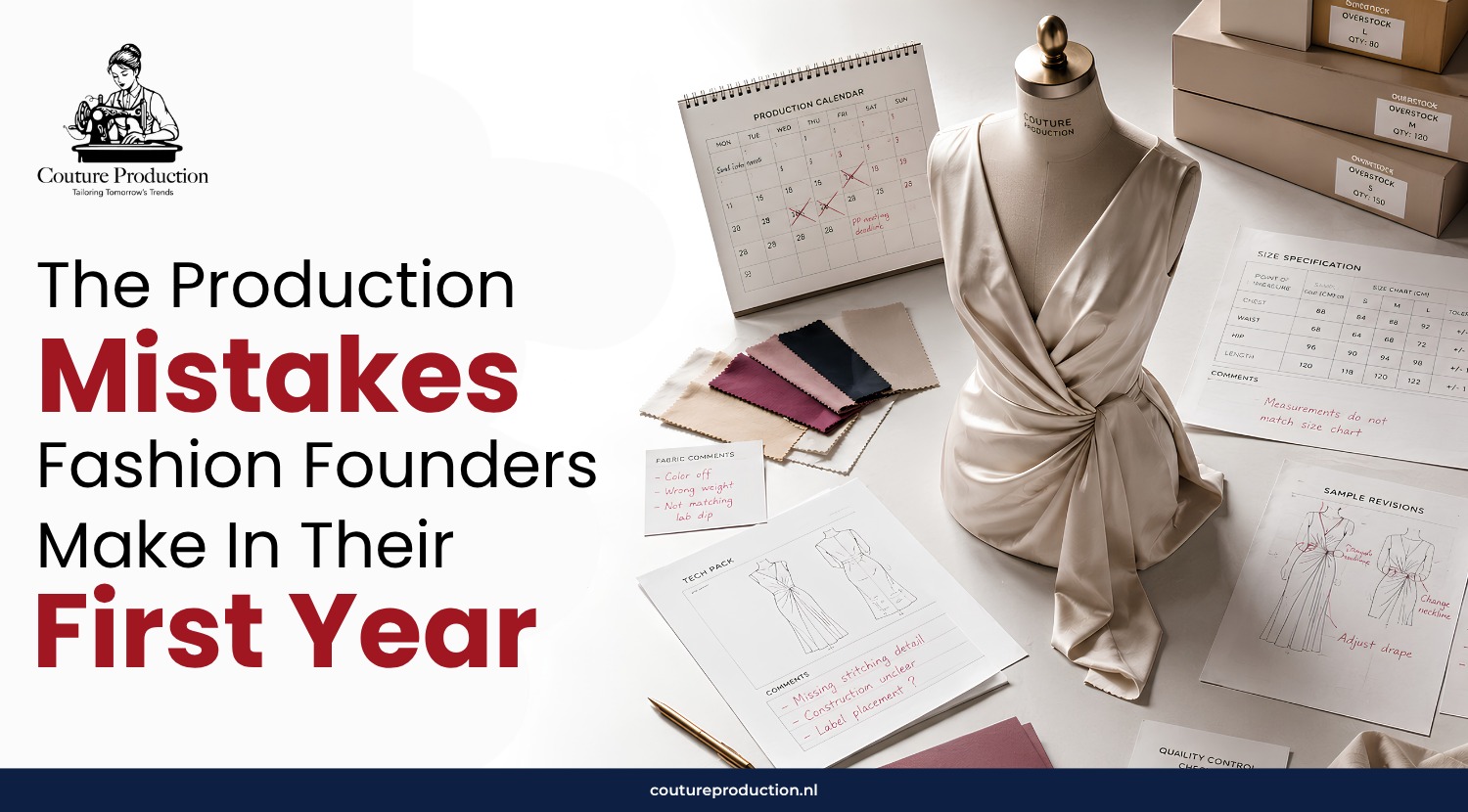
The Production Mistakes Fashion Founders Make In Their First Year
Launching a fashion brand has never been easier. Building a successful one has never been harder. Today, founders have access to powerful tools for branding, e-commerce, social media, and marketing. A new collection can be designed, launched, and promoted faster than ever before.
But while many fashion entrepreneurs focus on building visibility, they often underestimate the operational side of the business. And that is where many costly mistakes begin. Interestingly, most first-year production mistakes are not caused by poor intentions or lack of effort. They are caused by inexperience.
Founders simply do not yet know what can go wrong behind the scenes. The challenge is that production mistakes rarely stay operational. They quickly become customer experience problems, reputation problems, and growth problems. Here are some of the most common production mistakes fashion founders make during their first year—and what growing brands can learn from them.
Mistake #1: Choosing A Manufacturer Based On Price Alone
For many new brands, budget constraints are real. As a result, production decisions are often driven primarily by cost. The lowest quote wins. Unfortunately, the lowest quote often comes with hidden costs. Lower-quality fabrics, inconsistent finishing, limited quality control, poor communication, unpredictable lead times.
At first, the savings appear attractive. But when returns increase and customer satisfaction declines, those savings disappear quickly.
According to industry data, apparel e-commerce return rates often range between 20% and 30%, with sizing and quality concerns among the leading causes. For a growing brand, these costs can become significant. The cheapest production option is not always the most economical business decision.
Mistake #2: Focusing On Samples Instead Of Bulk Production
Many founders become confident after receiving an excellent sample. The garment looks perfect. The fit feels right. The quality meets expectations. The assumption is that bulk production will match the sample exactly.
Unfortunately, this is not always the case. One of the most common manufacturing challenges is maintaining consistency across larger production runs.
- Fabric variations.
- Construction differences.
- Finishing inconsistencies.
- Sizing discrepancies.
These issues often appear only when production scales.
Experienced brands understand that evaluating a manufacturer means assessing not only sample quality but also the systems behind production consistency.
Mistake #3: Underestimating The Importance Of Communication
Production is not simply about making garments. It is about managing information.
- Timelines.
- Specifications.
- Material availability.
- Quality requirements.
- Production updates.
When communication breaks down, production risks increase significantly. Many founders assume that once an order is placed, the process will run automatically. In reality, successful production depends on continuous communication and transparency.
Growing brands need partners who communicate proactively, identify risks early, and provide realistic expectations throughout the process.
Mistake #4: Scaling Before Building A Stable Production Foundation
Success can create pressure. A collection performs well, orders increase and demand grows. The natural instinct is to scale as quickly as possible. However, rapid growth can expose weaknesses in production systems.
A manufacturer that performs well with smaller quantities may struggle with larger volumes. Quality standards may decline. Lead times may increase. Operational challenges become more visible. Many fashion brands do not fail because they grow too slowly.
They struggle because they grow faster than their production infrastructure can support. The strongest brands scale carefully. They build operational stability before chasing aggressive expansion.
Mistake #5: Ignoring Quality Control Until Problems Appear
Quality control is often viewed as something that happens at the end of production. In reality, quality control should be integrated throughout the entire manufacturing process.
- Fabric selection.
- Pattern development.
- Sampling.
- Cutting.
- Construction.
- Finishing.
- Final inspection.
Every stage influences the final outcome. According to PwC consumer research, more than 70% of consumers consider consistency a key factor in trusting a brand. That trust is built through reliable quality. Not occasional quality. Consistent quality.
Founders who prioritize quality from day one create stronger foundations for long-term growth.
Mistake #6: Treating Manufacturing As A Transaction
Perhaps the most important mistake is viewing production as a simple supplier relationship. The strongest fashion brands do not look for factories. They look for production partners. There is a difference. A factory produces garments. A production partner helps support growth.
- Through communication.
- Through problem-solving.
- Through quality control.
- Through long-term operational thinking.
As brands scale, this distinction becomes increasingly important. Because manufacturing impacts far more than inventory. It affects customer retention, profitability, reputation, and long-term brand value.
What Successful Fashion Founders Do Differently
The most successful fashion founders share a common mindset. They think beyond the next collection. They think about sustainability, consistency, and scalability.
They prioritize:
• Reliable production partners
• Consistent quality standards
• Clear communication
• Operational planning
• Long-term customer satisfaction
Because they understand that fashion brands are not built through marketing alone. They are built through delivering on customer expectations repeatedly. Every order, every collection, every season.
Final Thoughts
The first year of a fashion brand is often filled with learning experiences. Some lessons are creative. Others are operational.
The production decisions made during this stage can influence growth for years to come. For founders looking to scale, manufacturing should never be viewed as a simple cost decision. It is a strategic business decision.
The right production partner helps brands avoid expensive mistakes, maintain quality, and build trust with customers. Because in fashion, growth is not only about attracting new customers. It is about consistently giving them a reason to come back.
Learn more about how Couture Production supports growing fashion brands:
Strong brands are built on strong foundations. Production is one of them.